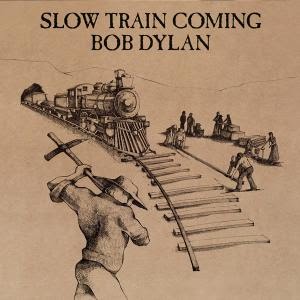
1. “Precious Angel” (1979). As we all know by now, Dylan wanted to record Slow Train Coming the way he would later record Saved--by going into the studio, singing and playing everything live in a take or two, then hitting the road. But Jerry Wexler--God rest his card-carrying, Jewish-atheist soul--would have none of it. He insisted on approaching the album as he had his many previous classics, convinced he could get a classic out of Dylan. So the rhythm tracks got cut first, the other instruments came next, and then and only then did Dylan sing. Wexler also brought in Mark Knopfler, who, despite the success of “Sultans of Swing” the previous year, was hardly an obvious choice. Wexler also apparently slowed “Precious Angel” down: The live version from the May 1980 Massey Hall (Toronto) show sprints by so fast you’d think Dylan thought the race went to the swift rather than the worthy who can divide the word of truth. In short, the song is as powerful a testament to the Wexler genius as anything else in his justly celebrated canon. Without Wexler, Barry Beckett’s glowing organ virtuosity would’ve barely glimmered. Without Wexler, there’d have been no deftly deployed Muscle Shoals horns. Without Wexler, Dylan would’ve been too impatient (and distracted by simultaneously strumming his acoustic) to have delivered what just might be to this day the clearest singing and enunciation of his career. And without Wexler, Knopfler wouldn’t have come through with guitar playing so beautiful it can break your heart.
 2. “Positively 4th Street” (1965). This song captures the righteous indignation of anyone who has ever been resented to the bone by those with a heart of stone so accurately that it’s almost worth being laughed at behind your back when you come walkin’ through just to be able to shout “I wish that for just one time / You could stand inside my shoes / You’d know what a drag it is / To see you” at your tormentors. And to break the icicles off the chilliest organ riffs ever and do one to others before they do one to you.
 3. “Please Mrs. Henry” (1968). O.K., so am I the only Bob Dylan and Cheap Trick fan in the world who didn’t know until the recent release of Setlist: The Very Best of Cheap Trick Live that Cheap Trick had recorded a maniacal ten-minute live version of this song under the title “Mrs. Henry”? (That’s what I get for not acquiring the Sex, America, Cheap Trick box fourteen years ago.) In case you haven’t heard it yet: Nielsen and Co. pound it out of shape then pound it back into shape again: It could make Manfred Mann roll over and tell Coulson, Dean, McGuinness, and Flint the news. It is, in other words, ridiculous. But so is the song itself, with “Now, I’m startin’ to drain / My stool’s gonna squeak / If I walk too much farther / My crane’s gonna leak” as fully deserving of a Best Restroom-Stall-Verse Grammy as anything by George Clinton.
 4. “Political World” (1989). The word “politics” was big on Dylan’s mind in the ’80s if only because interviewers kept asking him about it. Responding to Martin Keller in 1983, Dylan said that politics is “like a snake with a tail in its mouth. A merry-go-round of sin.” The next year, responding to Kurt Loder, he said that “politics is an instrument of the Devil.” So perhaps this song was Dylan’s way of saying, “You wanna know what I think of politics? Here it is. Now shut up!” It’s not a pretty picture: faceless crime, nameless gods, homeless kids, loveless technology, ruthless cowardice--everything is broken. And, in case future Dylan interrogators should miss the point, Daniel Lanois keeps piling coal into the engine until what had started out as a slow train quickly picks up steam and ends up smokin’ down the tracks like a runaway streetcar named desire.
 5. “Po’ Boy” (2001). Heard in sequence on Love and Theft, “Po’ Boy” is a change-of-pace old-timey shuffle, a sepia-tinted respite of wry comic relief between the smoldering twin towers of “Honest with Me” and “Cry a While.” If memory serves, this is one of those songs with lyrics lovingly stolen from Junichi Saga’s Confessions of Yakuza. (A la “Union Sundown”: “Well, this melody’s from Tin Pan Alley / And these words are from Japan.”) The lyrics also echo Dylan’s late-’90s obsession with telling corny jokes between songs in concert. (Note to Sony’s Bootleg Series overseers now that there’s no Col. Parker--er, Albert Grossman--to put it out: Having Fun with Bob on Stage.) Weirdest or coolest (or both) of all, though, are these lines: “My mother was a daughter of a wealthy farmer / My father was a traveling salesman, I never met him.” Does this mean the singer is the love child of those two crazy kids in “Motorpsycho Nightmare”?
 (Bob Dylan's Top-Five Songs Beginning with "O": http://tinyurl.com/2de5u4m)
This series will now take a hiatus. I must tend to the life that meanwhile has been going on outside all around me. Thank you to everyone who has been along for the ride so far.