Showing posts with label B-Side. Show all posts

Thursday, June 25, 2020

ARCHERS OF LOAF: TOLSTOY'S LAST STAND

Originally published in B-Side (April/May 1994)

During my years of writing for B-Side magazine, the editors imposed several silly style rules.  One was to refer to musicians by their first names.  (Had they interviewed Dylan, they’d have written, “Bob bristles when asked for the millionth time to explain ‘Desolation Row’”).  Another was never to write “said” or “says” in a direct-quotation tag, even though writing anything else usually causes readers to pay undue attention to the verbs.
As originally published, the piece that follows adhered to those two rules.  As slightly edited below, I’ve amended most of the quotation tags.  I have not, however, changed the first-names approach because, oddly enough, it seems to work in this context.  At any rate, I hope you enjoy what you’re about to read.  

* * * * *


Those who track the movements of alternative music’s restless muse tell us that Chapel Hill, North Carolina, qualifies as one of several college towns in contention for the title of the “next Seattle” (a title formerly known as the “next Minneapolis” and the “next Athens”).  These muse trackers cite as prime evidence Icky Mettle, the Alias Records debut of the sub-poppier-than-thou Chapel Hill racket makers Archers of Loaf, three of whom inaugurated their Christmas season by phoning this magazine from their manager’s house for a short winter’s chat and, simultaneously, watching Rudolph, the Red-nosed Reindeer.

“Oh!  Rudolph, the Red-nosed Reindeer with Burl Ives is comin’ on!” exclaims Matt Gentling, the band’s bassist, in the middle of his fellow Archer Eric Johnson’s explanation of how he makes his guitar sound like an air-raid siren on the song “Hate Paste.” 

“That’s that little noise thing that Eric made,” observes the drummer, Mark Price.

“I’ll tell you what it is,” says Eric.  “It’s a delay peddle—

“The claymation bit!” Matt interrupts.

“He wants to know about my brilliance, guys!” Eric objects.

“Oh, I’m sorry,” says Matt.

“O.K.  What I do,” says Eric, “for the kids out there—

“I want to be a dentist!” Matt interrupts again, mimicking the misfit elf on TV.

“—who reads this can take my advice ’cause I’m a guitar—

“Wizard,” says Matt.

“—connoisseur,” says Eric.

“What were you saying about the drummer?” says Mark.

Matt cracks up.  Eric tries again.

“What I was sayin’ is—

“Shut up!” shouts Mark.  

Matt cracks up again.

You get the idea.  One would hardly mistake an interview with the Loaf for an episode of Firing Line.  “We might as well go ahead and warn you that we always confuse interviewers,” says Eric (whom we shall henceforth refer to as “Eric J.” to avoid confusing him with the band’s lead-singing lyricist, Eric Bachmann).  “We’re very sarcastic.  Beware.”

Back to the air-raid-siren guitar sounds on “Hate Paste.”

“O.K.,” resumes Eric.  “What you do is you take the delay time and turn it all the way down, and then you take the repetition and turn it all the way up.”

“Then you get a dual motor crossover,” adds Mark.

“What you get is a sub-divided matrix,” adds Matt.

“What happens,” says Eric J., “is it’s impossible to have no delay time in a repeat.  So the peddle just starts, like, makin’ all this noise, and if you have a fresh battery in there—

“It’ll cook,” says Matt.

“—it’ll start screamin’, and boy does that get me off!”

Matt cracks up again.

“Print that,” says Matt.  “That’s a good quote.”

One should not assume from such banter that “Hate Paste” is the only Icky Mettle track to feature skronky guitar sounds.  Indeed, all thirteen songs—from the catchy, previously-available-as-45s “Web in Front” and “Wrong” to the downright entropic “Fat” and “Backwash”—bulge with the shrieks of tortured amps.  But just as essential are Eric Bachmann’s weird lyrics and the plaintively hoarse way that he shouts them in a sometimes vain attempt to be heard over the aforementioned guitars.  It was, in fact, the coming together of the two Erics in late ’91 that launched the entire Loaf concept, giving the quartet’s on-again, off-again involvement in various combos going back to high school a splattery, post-punk shape.

Eric B.’s absence on this night precluded questions about what he means when he sings lines such as “All I ever wanted was to be your spine.”  But Matt, Mark, and Eric J. have plenty to say about their frontman nevertheless, starting with the “intellectual” look lent him by his wire-rimmed glasses.

“It’s his Russian-novel reading,” says Matt.

“He’s really into reading Russian novels,” says Eric J.

“He has a big tattoo on his butt that says ‘Pain,’” says Mark.

“Yeah, exactly,” says Matt, “because that’s—

“That’s what it’s all about,” says Mark.

The trio’s discussion then moves on to the topic of Eric B.’s lyrics, lyrics that, although Matt, Mark, and Eric J. did not feel at liberty to discuss them, they discussed anyway.

“Um, I mean, we hate them,” says Matt, “and you can tell him that.”

“We try to keep them all the way down in the mix,” says Mark.

“We’re looking for a new frontman,” says Matt, “so if you have any suggestions—

How about Randy Bachman? 

“From Bachman-Turner Overdrive?  He’d be a frontman-and-a-half.  You don’t happen to know his number, do you?”


Icky Mettle hit the stands on September 13, approximately six months after Archers of Loaf signed to Alias Records.  The Alias A&R man John Wells heard the band’s first single, “Wrong” b/w “South Carolina” on the Stay Free label, and came to see the Archers play.  Before long, they’d joined the Alias roster.  And although it was recorded in March 1993, Icky Mettle still represents, according to Eric J. and Matt, what the band does onstage.  

“We’ve evolved,” says Eric J., “but not very far.”

“We’ve evolved from one side to the other,” laughs Matt, “not necessarily up or down.”

“I think we’ve gotten better.”

“Like, we’ve gotten a million times better, I think.  But as far as the songs that we’re recording now, it’s weird.  We have a couple of singles about to come out, and those are a pretty even mix of brand-new songs and really old songs.”

Broaching the subject of Eric B.’s lyrics again, Matt manages an at least half-serious appraisal.

“I like his lyrics because they’re pretty open to interpretation.  Usually, they mean something personal to him, but you can’t get too specific about them because they weren’t intended that way, I don’t think, unless maybe for his own use.

“‘Web in Front,’ however,” he says on second thought, “does refer to an obscure Russian novel.”

The other news about the Archers has to do with the seven-week tour that they completed just after Thanksgiving.  It amounted to their most extensive jaunt ever.  And while it provided plenty of thrills, it also provided monotony and exhaustion.

“The first two weeks felt like four weeks,” says Eric J., “and then the third week felt like a week-and-a-half.  And then the fifth week felt like just a week.  The seventh week felt like three weeks.”

“So in total,” Matt calculates, “it felt as if we were gone six months.”

And for those who still need a reason to trudge out and see the Loaf when they next hit the road in the spring, the following observation might serve as the ultimate motivator: They sound a lot like the Replacements probably did between Hootenanny and Let It Be.

“When I went to high school, they were like my personal messiahs, Matt recalls.  I worshiped them.  They’re like a significant portion of my life.  Yeah, that’s cool as hell, man.  I don’t mind being linked with them at all.”

Nor should those interested in the sound of the next Seattle mind being linked with Archers of Loaf, whether by concert ticket, CD player, or a love for Rudolph


Friday, July 23, 2010

Holy Barbarians: Cream (1996)

(As published in B-Side ... )

Holy Barbarian
Cream
(Reprise)


When last seen, Ian Astbury was leading a rapidly dwindling Cult cult into a psychedelic, heavy-metal wilderness from which he didn't seem likely to return any time soon. But miracles do happen, and if Cream, the debut outing from Astbury's new cult, Holy Barbarian, doesn't find Astbury completely back in touch with his roots, it still has moments of such down-and-dirty T. Rexiness that you'd swear the spirit of Marc Bolan had finally found a body suitable for possession. Chief among these moments is “Space Junkie,” a raunchy slice of sci-fi glam that owes as much to the Davids Johansen and Bowie as to Bolan. And there are others: the title cut, for instance, in which Astbury and his guitarist Patrick Sugg sing like all the young dudes, and “You Are There,” in which Astbury borrows the melody of “Like a Hurricane” for the chorus, swipes a line from Abba's “Does Your Mother Know” for the bridge, and makes some pretty awful lyrics tolerable for at least half of the song's five minutes. Alas, pretty awful lyrics have long been the bane of Astbury's songs, and “Bodhisattva” and “Opium” hit new lows with a thud. Don't be surprised, however, if this really takes off in non-English-speaking lands.

Monday, July 19, 2010

Juliana Hatfield: Miss Quoted (1993)

(As published in B-Side ... )

By celebrity standards, Juliana Hatfield’s inclusion of her mailing address on the sleeve of her 1992 Hey Babe album seemed like an uncommonly openhearted gesture. And for lots of the people who bought the album--teenaged guys especially--it was an invitation too openhearted to pass up.

So they’ve written her--and written her and written her. Not that Hatfield doesn’t appreciate their interest, but she has begun to wonder whether maybe their interest stems from something other than the Real Her.

“People think that my personality can be reduced to what’s in the songs on Hey Babe,” she says. “It’s not true. But people don’t realize that.”


Neither, apparently, do most music journalists, who, Hatfield maintains, consistently misrepresent her. And when they do so in such diverse and high-profile publications as GQ, Details, Interview, Sassy, and the Village Voice, the misrepresentations can become downright burdensome.

“My personality doesn’t come across in any of those stories,” insists the ex-Blake Baby of the many Hey Babe-centric articles that ran last year. “And I get misquoted all the time. It’s really crazy.”

She has two specific examples at the ready.

“There’s one example recently where I was talking about eating disorders, and I was talking about how I used to like to starve myself sometimes. And then I said, ‘But I never lost huge amounts of weight.’ You know, it wasn’t bad. And then in the article it says I lost huge amounts of weight.”

Her other example appeared in Interview and went like this:

(Interview) “When you’ve been obsessed about guys, has it been really painful?”
(Hatfield) “Yeah. That’s why I like telling the bastards so with my songs.”


“I never said anything like that,” says Hatfield. “Maybe their tape recorders didn’t pick up what I did say. Maybe their editors told them that they had to paint a certain picture of me. I don’t know.

“It used to upset me a lot, but now I take the attitude that it’s fine because you can’t describe a person or music in words anyway.”

Performers, of course, often find themselves puzzled by their public images, but Hatfield’s case
of mistaken identity seems more extreme. Her music, for instance, while promoted as “alternative,” defies easy categorization. And when you get down to a close examination of what she’s actually singing, the task of figuring her out becomes downright labyrinthine.

A case in point is her new album, Become What You Are (Mammoth/Atlantic), which has just hit the stores (and which, incidentally, does not include her mailing address). Credited officially to the Juliana Hatfield Three (Hatfield on guitar; Dean Fisher, bass; Todd Philips, drums), the album is a distillation of punk, sixties pop, and metal as heard from across an emotionally turbulent ocean by someone to whom it had never occurred that they might be separate.
Then there’s Hatfield’s distinctively crystalline voice. Whether cutting through power chords or hovering above them, it possesses a childlike quality that only enhances the complexity of her often structurally centrifugal lyrics.

The song “My Sister,” for example--in just three minutes and twenty-two seconds--develops from a gripe (“I hate my sister / She’s such a bitch”) into a plaintive admission of loss (“I miss my sister / Why’d she go?”), all within the context of Hatfield’s mysterious admission that she has never had a sister at all.


She does, however, have a brother.

“He says that the first time he heard me play it live it brought tears to his eyes,” she recalls with the satisfaction of someone who once listed moving people to tears as one of her goals. “It has the same effect on me, and I don’t even know what I was writing about. I made up the character in it.”

She credits such indirection in part to the intense interest in her private life generated by the explicitly confessional songs on Hey Babe, songs that many heard as pages from her diary whether they were autobiographically accurate or not.


“It made me write differently,” she explains. “It made me not want to write any kinds of love songs.”

But not writing love songs has posed challenges of its own. Take Become What You Are’s opening track, “Supermodel,” for instance, a song that sounds unusually superficial coming from Hatfield in that it trots out anti-glamour clichés to portray models as objectified victims instead of self-determining agents in the power game.

“I’m worried about the reaction I’m going to get to that song,” she says, “because I don’t think I articulated what I really wanted to say. It’s supposed to be a song about the public’s perception of models. I’m questioning that and trying to empathize with the model and know how she really feels.”

And Hatfield has a right: She has done some modeling herself.

She did not, however, enjoy it.

“I just felt really dirty,” she says. “I hated it. I wanted to cry at the end of the day.”

Why?

“People putting their hands all over you and pushing your body around and treating you like a piece of meat and just having to stand in one place for a long time,” she answers. “It’s uncomfortable.”

It's also, according to Hatfield, at least a little twisted. “It’s the public who exalts women for looking beautiful. And that’s fine. I mean, I love looking at beautiful girls and beautiful men. I’m just saying it’s such a weird nineties thing how people know all the models’ names when all they do is--be beautiful.”

“Supermodel,” she says, is “just talking about how fucked up that is that that’s one of the highest-paying jobs that a woman can aspire to.”

Still, her previous bad modeling experiences notwithstanding, she admits she might find a way to enjoy the job herself if she had to.

“I think I would,” she says. “I mean, to get paid so much money for doing nothing--with your brain.”

But only for awhile.

“I can imagine that after a few years of getting paid for being beautiful I’d be fucked up in the head,” she says. “What happens when you start getting wrinkles? Up until then you’ve been basing your worth on your looks. I think that’s all screwed up. Nobody cares about an over-the-hill model.”

The same, she says, does not go for over-the-hill rockers. “Neil Young’s still making great music, and it’s got nothing to do with the way he looks.”

She can say that again. But she doesn't. Instead, Hatfield lists Young at the top of her list of the performers whose songs she’d cover if she were ever to record an all-covers album. “I’d do a Neil Young song or two--or three,” she laughs. “And I want to maybe record that Leslie Gore song, ‘You Don’t Own Me,’ someday.”

And maybe something by Wilson Phillips, a group whom Hatfield confessed to liking last year and in so doing alarmed rock’s Hip Police.

“People think I’m a freak when I say that,” she says, “but it’s totally sincere. I like their music. They’re better singers than I am. I love the lush harmonies--all those different parts--and some of the songs are really good."

She has no desire, however, to meet the trio. “I’ve read interviews with them, and they sound like--weirdos.”

Some people think Hatfield is a weirdo because, at twenty-five, she’s still a virgin and doesn’t mind saying so. She’ll even say, “Yeah, me too,” if you tell her that you think the death of virginity has been greatly exaggerated.

But she denies that “I Got No Idols” from Become What You Are addresses the issue, even though it goes, “I don’t like to be touched / You might think we all need that stuff / But I don’t think about it much.” That song, according to Hatfield, is really “about how you should separate the art from the artist and leave the artist alone and not hold her responsible for everything because a lot of times the art is better than the artist.”


Her fans might be surprised to learn that she would also like to separate herself from Hey Babe..”

“It makes me want to cringe,” she said recently. “It just sounds sappy.” It doesn’t, but her attitude toward helps explain why its romantic brightness has been replaced on Become What You Are with a sound that’s darker and more ominous--sometimes subtly (as in the gently claustrophobic “Feelin’ Massachusetts”) and sometimes not so subtly (as in the Gena Rowlands-inspired “Mabel,” the rape-revenge fantasy “A Dame with a Rod,” and the self-explanatory “Addicted”).

Do not assume, however, that the album will cast a shadow over the Hatfield Three’s next project because it might not.

“I’m not letting myself write any songs for awhile,” she says. “I want the next record to have a distinctly different feeling, so I’m not going to write songs until I’m closer to recording it.

“I hope there’ll be a big change.”

Saturday, July 17, 2010

The Denison/Kimball Trio: "Almost Rockin'"! (1994)

(As published in B-Side ... )


In the November 1994 issue of the Illinois Entertainer, J. Kevin Unsell concluded his review of the Denison/Kimball Trio's debut album, Walls in the City, thus: "I cannot heap enough praise on this recording.... The Denison/Kimball Trio leads the pack for unstructured, avant-jazz genius."

Unsell errs in calling the Denison/Kimball Trio’s music "unstructured" (it's not). But he's right when he says that Denison/Kimball "lead the pack" of alternative jazz types.

Of course, it's not exactly a burgeoning field--or is it?

"There are some other bands in Chicago doing instrumental, jazz-like kinds of things," reports Jim Kimball, the Trio's drummer. "There's nothing exactly like we're doing though."

There’s certainly no other “trio” with only two members. Although their forthcoming second album, Soul Machine, features special guests, Kimball and his guitarist buddy Duane Denison (of Jesus Lizard renown) make ninety-five percent of their music unassisted.

And Kimball doesn't consider their music "jazz."

"Jazzy," he corrects. "I consider myself more of a rock drummer, and Duane considers himself a rock guitarist, I think. We're not going to get a big attitude as if we're some kind of ‘jazz’ musicians, which we aren't."

Nevertheless, Kimball cites Buddy Rich and Max Roach as his earliest drum heroes, and on Soul Machine the "trio" tackles Ornette Coleman's 1959 classic, “Lonely Woman.”

"We do it more upbeat," Kimball says, "kind of rockin', almost Latiny. It sounds different than any other version I've ever heard of it."

In a sense, Soul Machine is Denison/Kimball's real debut. Walls in the City captures many of the duo's strengths, but its functioning as the soundtrack to the Jim Sikora film of the same name inevitably limits the number of ways one can hear it.

"Duane pieced together things that were appropriate for different scenes in the movie,” says Kimball. “Then, when we were in the studio, we were actually watching the movie and playing to the action for about a third of the record.”

He prefers Soul Machine’s wider sonic variety.

"It’s a lot more well rounded. We had extra musicians play--keyboards on one song, sax on one song, and bass on one song. The first one's kind of themey soundtrack music. Soul Machine has some soft stuff and some more aggressive stuff that's almost rockin'."

Still, Walls in the City has charms of its own. Perhaps because such "jazzy"-ness represents one of the bigger steps that alternative rockers have taken away from grunge-for-grunge's sake, it sounds soothing, if not quite smooth. Denison's rigorously rippling guitar work, even in the service of quieter textures, sees to that.

"Duane's a genius," Kimball chuckles. "He's really a lot of fun to play with because he has so many ideas. So some of the stuff on the new record is really free. We recorded two or three of the tracks the first time we played them. And though Duane has written most of the material, there's a lot of space for me to do whatever I want within the context of the song.

"There are only two of us,” he says, “so there's a lot of space. And some of it needs to be filled up."

Saturday, July 10, 2010

Cindy Lee Berryhill: Straight Outta Marysville (1996)

(As published in B-Side ... )

Cindy Lee Berryhill
Straight Outta Marysville
(Earth/Cargo)


Like most fourteen-song CDs, this follow-up to Berryhill's '94 breakthrough Garage Orchestra goes on too long. But, also like most fourteen-song CDs, it can also be edited with a programing button. The songs to skip are the ones that sound forced: “The Virtues of Being Apricot” and “Talkin' with a Mineral” come off gratuitously flakey, and “Elvis of Maryville” and Donovan's “Season of the Witch” do little with their evocation of rock iconography. Only when Berryhill anchors her writing in verbal or musical hooks does she avoid drowning in quasi-Dylanisms ("Picasso's in the living room playing with the baby boom") or floating off with her helium-filled voice; with such anchors deployed, she scores big. Vibraphone and cello elevate “Unwritten Love Song” into twilight time, sheer verbal energy strips the empathetic “Just like Me” of pretense, and a happy religious fatalism turns “Unknown Master Painter” into a livelier piece of Deistic folk-rock than either “From a Distance” or “One of Us.” Then there's the truly oddball “Diane,” Berryhill's confession of love for a girl who used to be a guy or vice versa. (It's unclear what the doctors have "turned inside out.")

Penelope Houston: Cut You (1996)

(As published in B-Side ... )

Penelope Houston
Cut You
(Reprise)


Nearly twenty years after she came and went as the leader of San Francisco's punk Avengers, Penelope Houston is back with an album that's part sampler (eight re-recorded songs from her recent Europe-only releases), part new EP (six new ones), and only a little too long for all that. Not that the credits say what's new and what's old. So whether she's a slowly maturing folky with an unusual affinity for distilling her internationally acquired influences into a potent brew (as the mandolin-enriched “Secret Sign,” “Sweetheart,” “Scratch,” “Locket,” and “Harry Dean” would indicate) or whether she's a slowly deliquescing singer-songwriter who can't quite bring herself to call it quits (as the wordy and amelodic “Fuzzy Throne,” “Pull,” and title cut would indicate) is impossible to tell. Meanwhile, punk hasn’t disappeared entirely from her program. On both “Ride” and “Glad I'm a Girl,” she recalls Debbie Harry without tripping nostalgia alarms. But since when do purveyors of feminist punk-pop anthems call themselves "girls" in the first place? Apparently since they first realized that career longevity sometimes involves the gradual working out of contradictions over a long period of time.

Chune: Big Hat, No Cattle (1996)

(As published in B-Side ... )

Chune
Big Hat, No Cattle
(Cargo/Headhunter)

This disc has only six songs, but don't figure it for an E.P., not when all six keep going and going (and going). Sometimes you'll think one's over, but then it's final chord will take forever to fade, or its final drum crash will keep rolling only to peter out a minute or two later. The song titles, on the other hand, are over really fast: “Dated and Jaded,” “Water Sandwich,” “Fishwrap,” “One-Man Dream Machine,” “Playboys and Tourniquets,” and--my favorite--“Duel Rectums” (good thing they didn't call it “Dueling Rectums”). What makes the disc tolerable-to-enjoyable on the whole is that Andy Harris sings with the ravaged-but-unbowed enthusiasm and skill of a displaced pop singer. Stick him in front of a tight combo, throw in background singers and maybe a producer, and who knows? He might even get invited to sing at Sinatra's 90th. For now, however, the sloppiness of his three Chunemates betokens fatigue and sloppiness-for-its-own-sake instead of the youthful rebelliousness it was undoubtedly supposed to. Or, to put it another way, at such exhausted tempos and never-ending lengths, each song sounds as if it were supposed to be the last song on the album. And, of course, only one of them can be.

Thursday, July 8, 2010

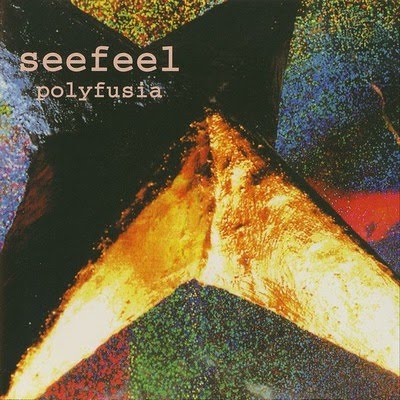
Seefeel: Music to Wash Up To (1994)

(As published in B-Side ... )

For the past year-and-a-half, British critics have waxed inventive in trying to describe the techno, tabula-rasa-from-the-hearts-of-space sound of the three lads and a lass from London known as Seefeel.

"[O]ver a foetal-heartbeat bassline,” wrote Simon Reynolds, “billowing cirrus-swirls ... weave together to form a shimmering outerspace/innerspace wombscape."

You get the idea.

One phrase, however, continues to surface.

"The words 'ambient noise' keep coming up," says Sarah Peacock, Seefeel's twenty-four-year-old siren. "I don't have any objection to that in itself. But we don't start off with a genre and then make the music to fit it, you know?"

In other words, if Seefeel's two U.S. longplayers, Polyfusia and Quique, sound like ambient music to you, fine. But Peacock, Mark Clifford (guitar and gadgetry), Daren Seymour (bass and gadgetry), and Justin Fletcher (percussion and gadgetry) didn't plunge into the burbly, non-verbal waters of synthetic effervescence for that reason. No, sir. They did it because--well, why did they do it?

"Some people have said it's very good music to wash up to," Peacock says, "but I hope people dance. When we play live, certainly people do get down and shake their things."

She laughs at her use of disco lingo. After all, nothing could be further from Saturday Night Fever than Seefeel's hypnotic, sub-verbal, cumulus clouds of tape-doctored sound, could it?

"Well, but there's always a groove to it. Everything we do has something about it that you can move to if it's loud enough, if the circumstances are right. I've got no objection to somebody's chilling out to it or whatever, but that's not why we make it, really. The stuff that turns us on is usually exciting stuff, stuff that makes you want to dance. That's what I want, certainly.

“I mean, sure, we have got some stuff, I suppose, like 'Signals' on Quique, that hasn't got any beat. You couldn't really dance to that. But I hope our music is more kind of head-fuck ambience than chill-out ambience, if you like. We want it to be challenging rather than background music. Yeah."

Like a cross between Tangerine Dream and Lou Reed's Metal Machine Music?

"Um, I'm sure I've probably heard some Tangerine Dream," Peacock equivocates, "but I haven't got any of their records. That was well before my time."

Quique (pronounced keek) and Polyfusia (a compilation of two pre-Quique EPs) have washed ashore courtesy of Caroline, but Peacock says Seefeel's future projects will bear the Warp Records imprint, probably in conjunction with one of the major labels that Warp is currently negotiating with. Meanwhile, those with London connections can already purchase two post-Quique discs: the "Starethrough"/"Filter Dub"/"Signals" twelve-inch and the official Starethrough EP.

But, commerce aside, just how does Seefeel generate its sounds?

"A lot of it is done with a sampler," Peacock explains, "pretty much nearly all of it. But the things that we sample are created by ourselves rather than taken off other records. We'll sort of make up percussion sounds and little pieces of effected guitar and things like that, sped up, slowed down, messed around with on the sampler, and usually repeated and looped. Then we'll add bass lines and vocals."

Are Peacock's diaphanous, wraith-like vocals sped up and messed around with too?

"Um, never all that much, no. I mean, there'll be a bit of delay and a bit of reverb. I think 'Charlotte's Mouth' on Quique had a bit of the weird effects on it--I was singing through a guitar amp--but it's never usually very much."

And what does she make of the notion that says the more techno the instruments, the less emotional the songs?

"I think that's bollocks, really. We put a lot of emotion into our music. You can be totally passionate with a sampler. You can bang keys on a keyboard, and it can be, you know, straight from the heart just as much as thrashing on a guitar or singing the blues, as long as you're setting out to be yourself and be honest about what you're doing, which we are, I hope, in our striving to be something different.

"We are trying to be really honest with that, you know. And I hope we succeed."

Tuesday, July 6, 2010

Smoking Popes: Brothers in Arms (1995)

(As published in B-Side ... )

There's a lot to like about Chicago's Smoking Popes.

First, there's the name, a casually provocative moniker in a scene overrun with desperately overreaching ones. Second, there's the restraint: In a scene overrun with hour-plus CDs, the under-thirty-minute length of Born to Quit, the quartet's second album and first for Capitol, comes as sweet relief.

And, of course, there's the music, catchy garage pop that, like the band's name, doesn't so much push the envelope as delight in licking the stamp. Which stamp? Why, Elvis obviously. But which Elvis? The young, skinny one or the old, fat one?

"Elvis Costello,” says Josh Caterer, Smoking Popes’ lead singer and one of three Caterer brothers in the band. “I would say he’s my all-time favorite musician. His singing moves me more than any other singer's. And I like all his stuff, although I'm apparently one of the few people who do."

Caterer isn't kidding--he even likes Kojak Variety. But the real significance of his Costello worship lies in what it puts the lie to: namely, that Caterer’s tender tenor singing must betoken a Morrissey jones. It doesn't. It betokens a Rat Pack-era crooner jones--sort of.

"I do have a great affection for that kind of music and that kind of singing," he confesses, "but it's not any deeper than my affection for other kinds of music." Nevertheless, between his and his father's record collections, he has access to more crooner pop than the average up-and-coming twenty-something rocker. And since his signing to a major label, his access has improved.

"I have a ton of Frank Sinatra because we're on Capitol, and we, um, get all that stuff for free. My favorite one is At the Sands with Count Basie. But I also really enjoy Sinatra and the Sextette Live in Paris and In the Wee Small Hours.”

O.K., so he didn’t mention September of My Years or She Shot Me Down (probably because those were on Reprise). Still, Caterer’s no crooner dilettante. He can also go on about Mel Torme, Johnny Mathis, Nat "King" Cole ("although he's a little different from those other guys"), and Judy Garland.

"I really like Judy Garland, but sometimes her singing is so heavy that I can't listen to it because it affects me too profoundly, especially later Judy Garland, when she really started to belt. You can't really use Garland as background music. You just have to turn the lights down and get into it."

Speaking of turning down the lights and getting into it, a lot of Smoking Popes fans spent the summer of '95 doing just that as the band traveled the club circuit with Goo Goo Dolls and Australia's You Am I. But despite Josh's ready praise for both You Am I ("They're a great band") and the Goo Goo Dolls ("Everybody went crazy for those guys"), at least one reporter thought Smoking Popes stole the show.

"Capitol's Smoking Popes won the crowd over," wrote Reuter's Troy Augusto of the night the tour played Hollywood. "Josh Caterer sang his charming love songs with a graceful nonchalance, and his brothers Eli and Matt, guitarist and bassist, respectively, added gritty muscle...."

"Well," says Caterer, "you can never trust a review of a show because it depends too much on the mood of the reviewer and where he's sitting or standing."

So much for hubris. Actually, Caterer's refusal to admit that his band might've, well, "smoked" that night is characteristic of his soft-spoken humility in general. And since humility's a liberating thing, it enables him, his brothers, and their drummer, Mike Felumlee, to play their energetic, three-minute songs for both more and less than mere attitude.

For example, not since tin-eared baby boomers thought John Lennon was singing "The girl with colitis goes by" on “Lucy in the Sky with Diamonds” has a band made a disease sound as embraceable as Smoking Popes do on "Rubella." Actually, it’s less an evocation of swelling glands than a love song for a girl with an embarrassing name. And it summarizes what the Caterers-Plus-One do best: support hummable melodies as crooned by Josh with hummable and slightly distorted power chords as strummed by Eli.

Perhaps the only thing the Popes do better is, in fact, smoke. "Let me see," says Caterer. "I've smoked for eight years now, since I was fifteen. We all smoke, although that would never been a requirement to get into the band."

One might expect Caterer to have an opinion about tobacco issues, like the irony of cigarettes becoming less and less legal at a time when the demand for marijuana legitimization has never been more bipartisan.


He doesn't.

"I try not to have opinions about social moods in general," he says. "and I think I'm a happier person for it."

As the upbeat nature of Born to Quit's ten songs suggest, Smoking Popes take their happiness seriously, even though, as with their other unique qualities, Caterer downplays its significance.

"I just happened to be interested in writing non-pessimistic, romantic songs at the time we were doing that record. They seemed all right, so we thought we'd run with it as a kind of theme for the record. But we actually have enough songs to record another album, and most of them have a little bit more of a somber feel to them."

Yet "somber" by Smoking Popes standards will probably still come off fairly chipper. Could the roots of the Caterer's contentment lie in the fact that their band is largely a family affair?

"That could explain it. Obviously, I get along very well with my brothers, and we get along very well with our parents. We've had a relatively stable home life, and, you know, I'm sure that's helped."

Judging from the evidence on Born to Quit, it certainly hasn’t hurt.

Sunday, July 4, 2010

Salt: Auscultate (1996)

(As published in B-Side ... )

SALT
Auscultate (Island)


Fresh from Stockholm but apparently not fans of Abba, this two-man, one-woman trio bashes out two-chord anthems in minor keys and at full volume, sounding at their dullest like P.J. Harvey backed by Candlebox and at their sharpest like P.J. Harvey backed by Nirvana. Actually, they're at their best on “So,” in which they let up a little and allow for both a prominent acoustic guitar and a pretty chorus. They're at their second best on “Bluster,” which starts out like just another two-chord, minor-key excursion and ends up incorporating an impressively medieval, Led Zeppelin-like bridge. It doesn't actually lead anywhere, but its incongruity makes it the perfect analogue for the lyrics, which also don't lead anywhere because they were written by the lead-singing Nina Ramsby, for whom English is a second language. Sometimes her jumbled syntax results in happy accidents ("Don't want to / Don't want to / Be inert / Inert"). Her foreigner's articulation, however, is another matter. I mean, does anyone have the heart to tell her that eagerness--as in "Got to keep my eagerness inside me"--is not pronounced anus?

Ammonia: Mint 400 (1996)

(As published in B-Side ... )

AMMONIA
Mint 400 (Murmur)

Once in a while, one should reflect upon the fact that not only have way too many rock albums been made since the beginning of time--when was the last time you dirtied your digits fingering endless racks of classical cut-outs?--but also that way too many rock albums get made every year. Ammonia give rise to such reflections not because their retooled heavy metal has no appeal--when was the last time you listened to an album of retooled heavy metal with no appeal (except for Candlebox, I mean)?--but because bands should only retool heavy metal if they have improvements to make. Instead of improvements, this trio from the land of Silverchair putty over the contours of their streamlined hooks until nothing sharp or prickly remains. "Ah," you argue, "but Ammonia aren't heavy-metal. They're alternative." And if by "alternative" you mean "sloppy metal," you're right. But once in a while, you should reflect upon the fact that way too many sloppy-metal albums get made these days, and then upon the fact that not even after a month of regular exposure to these twelve songs can you remember how one of them goes.

Saturday, July 3, 2010

Touch of Oliver: There Once Was a Fellow Named Diarmuid ... (1993)

(As published in B-Side ... )

You’d never know it from his breathily yearning singing on Touch of Oliver, the Bar/None debut by his band of the same name, but Diarmuid O'Sullivan has one of the most explosive laughs in indie rock.

And he laughs at almost anything.

Like when I begin my trans-Atlantic phone conversation with him by asking, "Is this Mr. O'Sullivan?" and he answers, "Yeah. A-ha-ha-ha-ha!"

Must be an Irish thing.

Touch of Oliver hails from the same town in southwest Ireland--Limerick--as the Cranberries, whose coattails O’Sullivan’s band might yet ride into some semblance of fame and fortune, what with Dolores O’Riordan’s singing backup vocals on Touch of Oliver’s “Carousel” and all.

But, “Carousel,” brogues, and a propensity for creating songs with subtly surging hooks aside, the two bands have little in common. For one thing, O’Sullivan sings nothing like Dolores O'Riordan--not even when, as on “Why” and “Burn,” he ratchets the intensity up a notch. For another, Touch of Oliver hates to tour.

"I don't reckon," O’Sullivan reckons when asked whether Touch of Oliver will support its album by performing in the U.S.--the only country, as of this writing, where trackers of the Limerick muse can buy it. "The earliest we could get over anyway is September, I think. So I doubt if we will, to be honest with ya."

O’Sullivan says that a lot: "to be honest with ya." He says "Do you know what I mean?," "I dunno," and "like" a lot too--such as when he's asked how it is that he and the three other lads in Touch of Oliver can be burned out from playing live when they’re only twenty-one.

"I dunno. I just didn't really like doing it, like, and neither did the lads really, like. You just get socked around too much, like. It's too much trouble unless it's well put together. Like, we never put together a proper tour. Do you know what I mean? Like, they never ran properly, like. Like, you'd be socked over in most of the venues. Do you know what I mean?"

What he means is that if you live in the U.S. and like the thirteen tracks on Touch of Oliver--as you should since seldom has the ever-popular guitar-jangle ethic been subjected to such a fetchingly rough-around-the-edges stripping down--you're going to have to wait a long time to hear the music live.

And that goes for residents of Limerick as well.

"For a couple of years, we were very popular in Limerick," says O’Sullivan in reference to the esteem in which the locals held his band. "But then we started getting pissed off, like. I don’t know. It's terrible to be on a circuit and not getting out of it. And that's the way it got, like. It was really bad.

"It started off really well. Like, it was getting higher and higher. Then it started getting lower and lower again. A-ha-ha-ha!"

O’Sullivan, Brian Corr (bass, keyboards), Hugh Mulqueen (lead guitar), and Willie Banks (drums) met in secondary school around the age of twelve. By fifteen they'd begun performing cover versions of popular hits of the day.

"Ridiculous covers," O’Sullivan confesses.

Like, how ridiculous?

"A-ha-ha-ha! Oh, I couldn't--I wouldn't even say it. Like, I couldn't, like. A-ha-ha-ha! I couldn't bring myself to tell you, like. They're that bad, like. A-ha-ha-ha!"

Golly. Are we talking Debby Boone? Scandal featuring Patty Smyth? Scandal Not featuring Patty Smyth?

"Like, things like U2, stuff like that. A-ha-ha-ha!"

And for once O’Sullivan’s laughter makes sense: Bono can be pretty funny--and ridiculous--when you think about it.


Not surprisingly, Touch of Oliver doesn’t sound like U2 either.

"The lads just loved it, but I hated them, like, to be honest with ya. I never really liked them. Actually, don't say--God, I don't want to be bitching in any kind of form, like, kind of--you know what I mean?"

What O’Sullivan means is that he has little room to criticize other bands because, as fifteen-year-olds, he and the other Touch of Oliver lads weren't exactly paragons of musical excellence themselves.

"Terrible," he says. "A-ha-ha-ha! Our first gig, our drummer played a dustbin. A-ha-ha-ha-ha! I'm pretty sure he did. Like, I can't remember if he had two dustbins, but he definitely had one. A-ha-ha-ha!"

By 1991 or so, after splitting up and getting back together in various configurations for a few years, O’Sullivan, Corr, Mulqueen, and Banks reformed for a go at, if not the big time, at least something bigger than the local cabaret and pay-to-play circuits they'd grown weary of. This meant, among other things, shopping a demo around.

"We did a demo about six months after getting back together again. And it was pretty good, like. I mean, the playing was diabolical, now that I think back to it, but at the time I thought it was pretty good."

Eventually a tape landed in the hands of Tom Prendergast, the head of Hoboken, New Jersey's Bar/None Records--and, as the luck of the Irish would have it, a native of Limerick himself. According to legend, he cried when he heard it.

O’Sullivan suspects it was the “desperation” in the songs that got to Prendergast, and certainly an urgency of sorts propels Touch of Oliver’s songs, from the very mellow “Click” to the aforementioned and slightly less mellow “Carousel.” “I dig a hole, I dig a well,” he sings in the latter. “I try to save me from myself.” And the refrain of “Mind Bomb Blind” is the acutely discomfiting “She burned my skin!”

Sounds pretty desperate to me.

"They're probably mostly desperate, like. A-ha-ha-ha! Desperate feelings, like. That's the only word I like to describe most of the songs. Not all of the songs or anything like that. I don't think they're that--I dunno. I wouldn't want to get into describing them, to be honest with ya."

Which means folks will have to figure out Touch of Oliver the old-fashioned way--by listening for themselves. And if they like what they hear, there’s good news.

"I reckon we've already written another album," says O’Sullivan. "I think we have another two albums. A-ha-ha-ha!

“Like, we have a load of material ready to go."